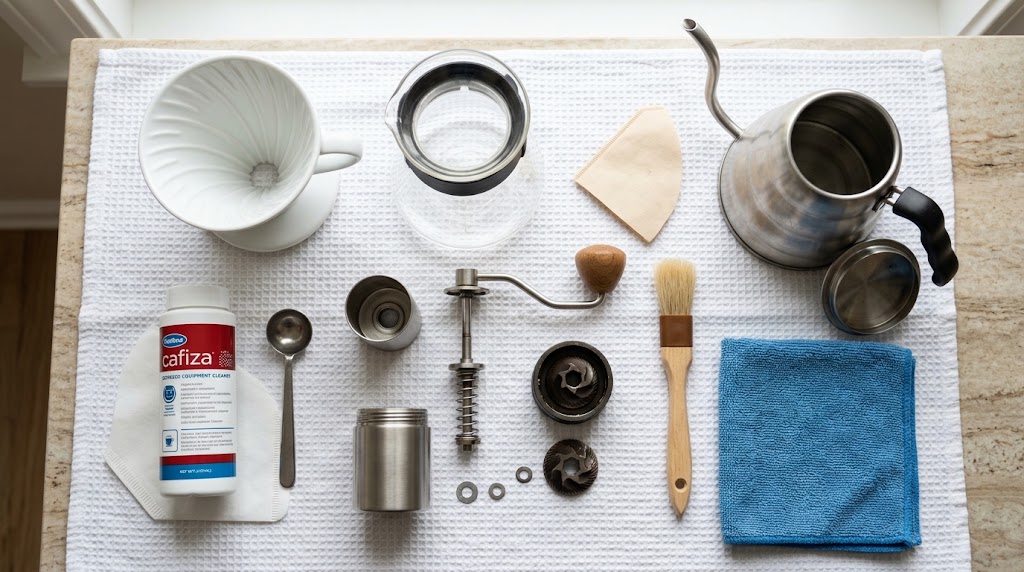
For illustrative purposes only — not the exact product reviewed.
Cleaning and Maintaining Your Pour-Over Gear
You wouldn't cook dinner in a pan coated with last week's burnt grease, but plenty of coffee lovers brew daily with stale oils baked into their grinder burrs and mineral crust lining their kettle. Dirty equipment doesn't just look bad; it actively degrades flavour. Old coffee oils turn rancid within days and add a harsh, cardboard-like taste to everything they touch. Here's how to keep every piece of your setup clean and performing at its best.
Your Grinder: The Most Neglected Piece of Gear
Coffee grounds are oily. Every time you grind, a thin film of those oils coats the burrs, the grinding chamber, and the chute. Over days and weeks, that film oxidises and turns rancid. Mix rancid old oil with fresh coffee and the result is a flat, stale note that no amount of technique can fix.
Weekly: Brush and Blow
After your last grind of the day (or at least once a week), disassemble the outer burr and use a stiff-bristled grinder brush to sweep out retained grounds. Blow gently through the chute to dislodge particles stuck in corners. For hand grinders like the Timemore C2 Max, unscrew the outer burr assembly and brush both burrs individually.
Monthly: Grinder Cleaning Tablets
Purpose-made grinder cleaning tablets (like Urnex Grindz) are food-safe pellets that absorb oils as they pass through the burrs. Run a capful through your grinder, then grind a small amount of sacrificial beans to flush out any tablet residue. This removes the baked-on oil layer that brushing alone can't reach.
Never: Water
Don't wash steel burrs with water unless the manufacturer explicitly says you can. Moisture causes rust on carbon steel and degrades bearings. If your burrs are stainless steel (check the manual), a quick wipe with a damp cloth is fine, but dry them thoroughly before reassembly.
Your Kettle: Fighting Scale Buildup
If you live in an area with hard water, mineral deposits (limescite, also called "kettle scale" or "limescale") will coat the heating element and interior walls of your kettle. This isn't just cosmetic: heavy scale insulates the heating element, slowing boil times and eventually shortening the element's lifespan.
Monthly: Citric Acid or Vinegar Descale
Fill the kettle with a mixture of equal parts water and white vinegar, or dissolve a tablespoon of food-grade citric acid powder in a full kettle of water. Bring it to a boil, let it sit for 20 to 30 minutes, then discard and rinse thoroughly with fresh water. Boil a full kettle of clean water and discard it to flush any residual taste.
For premium electric kettles like the Fellow Stagg EKG, Fellow recommends citric acid over vinegar to protect the stainless steel interior. Check your kettle's manual for specific guidance.
Weekly: Rinse After Use
Don't leave water sitting in your kettle overnight. Standing water accelerates mineral deposits. Empty the kettle after your last brew and leave the lid open to air-dry.
Your Dripper: Simpler Than You Think
Ceramic and glass drippers (like the Hario V60) are easy to clean: a rinse with hot water after each brew and an occasional scrub with dish soap is all they need. Coffee oils don't bond strongly to glazed ceramic or borosilicate glass.
Stainless steel drippers (like the Kalita Wave 185) can develop a brown film over time. A soak in a solution of Cafiza cleaning powder and hot water for 15 minutes removes this completely. Rinse well afterward.
Plastic drippers are the easiest of all. They don't stain, they don't absorb oils, and they're dishwasher-safe. Some brewing purists actually prefer plastic for this reason.
Your Scale: Keep It Dry
Coffee scales live in a splash zone. Water drips, coffee grounds scatter, and the occasional spill is inevitable. Most barista scales are water-resistant but not waterproof. After each session, wipe the platform with a dry cloth. If coffee liquid pools around the edges, dry it immediately. Store the scale in a dry place, not next to a steaming kettle.
If your scale readings start drifting (showing inconsistent weights for the same object), check the batteries first. Weak batteries cause erratic readings long before the low-battery indicator appears.
Your Server or Carafe: The Oil Trap
Glass carafes develop a brown film on the inside that regular dish soap barely touches. The most effective solution is a teaspoon of Cafiza dissolved in hot water, swirled around the carafe, and left to soak for 10 minutes. The alkaline cleaning powder cuts through coffee oils instantly. Rinse thoroughly; you don't want cleaning powder in your next brew.
For thermal carafes and insulated mugs with narrow openings, effervescent cleaning tablets dropped into hot water do the work without requiring a brush to reach the bottom.
Maintenance Schedule at a Glance
- After every brew: Rinse dripper, wipe scale, empty kettle
- Weekly: Brush grinder burrs and chute, wipe down kettle exterior
- Monthly: Run grinder cleaning tablets, descale kettle, deep-clean carafe
- Every 6 months: Inspect grinder burrs for wear (replace if visibly rounded), replace kettle filter screen if applicable