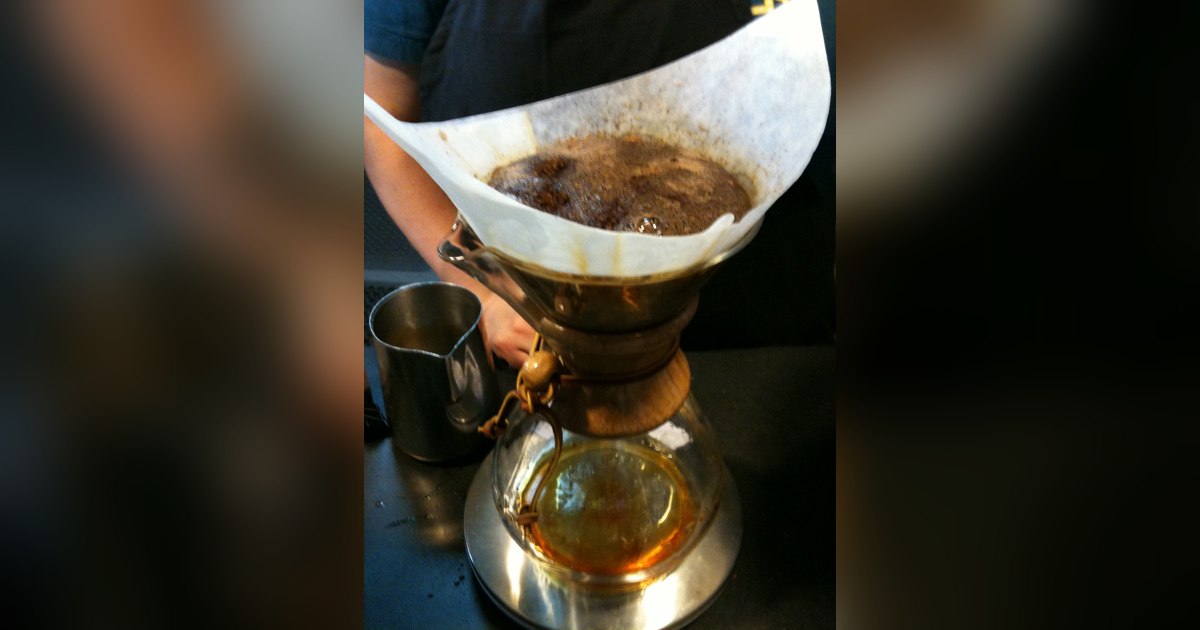
Image: naotakem via Flickr (CC BY 2.0). For illustrative purposes only — not the exact product reviewed.
How to Dial In Your Pour-Over Recipe
Dialling in is the process of fine-tuning your brewing variables until the coffee in your cup tastes exactly the way you want it to. It sounds fussy. It isn't. It's just a systematic way of making small changes and paying attention to what they do. Once you get the hang of it, you'll stop following other people's recipes and start building your own.
The Four Variables You Control
Every pour-over recipe comes down to four things. Change one, and the coffee responds. Change two at once, and you lose track of cause and effect.
1. Dose and Ratio
The ratio is how much coffee you use relative to water, expressed as something like 1:15 or 1:17. A 1:15 ratio (15 grams of coffee to 225 grams of water) produces a stronger, more concentrated cup. A 1:17 ratio (15 grams to 255 grams) is lighter and more delicate. Start at 1:16 and adjust from there.
A scale with 0.1g precision takes the guesswork out of this. Eyeballing coffee dose is the fastest way to get inconsistent results.
2. Grind Size
This is your primary extraction control. Finer grinds extract more, coarser grinds extract less. See our grind size guide for a full reference. In practice, adjusting by 1 to 2 clicks on your grinder between brews is enough to notice a clear difference.
3. Water Temperature
Hotter water extracts faster and more aggressively. Cooler water is gentler. The standard range is 90 to 96 degrees Celsius. Lighter roasts benefit from higher temperatures (93 to 96 °C) because they're denser and harder to extract. Darker roasts taste better at lower temperatures (88 to 92 °C) because they're already very soluble and higher heat pulls out burnt, ashy flavours.
A variable-temperature kettle like the Fellow Stagg EKG makes temperature adjustment trivial. If you're using a stovetop kettle, a model with a built-in thermometer is the next best option.
4. Time and Technique
Total brew time is partly a consequence of grind size (finer = slower drain) and partly a function of how you pour. Pouring faster raises the water level and increases pressure on the bed, speeding up flow. Pouring slower lets the water level drop and slows things down. Pulse pouring (adding water in stages with pauses between) extends contact time versus a single continuous pour.
The Dialling-In Framework
Here's the approach that most experienced brewers use, stripped down to its essentials:
Step 1: Lock Your Dose and Ratio
Pick a ratio and stick with it. 15g coffee to 250g water (1:16.7) is a safe starting point. Don't change this until everything else is dialled in.
Step 2: Lock Your Temperature
Set your kettle to 93 °C and leave it there. Temperature adjustments are a fine-tuning tool, not a starting point.
Step 3: Adjust Grind Size by Taste
Brew, taste, and assess. The two questions you're asking are always the same:
- Is it sour, thin, or tea-like? That's under-extraction. Grind 1 to 2 clicks finer.
- Is it bitter, dry, or harsh? That's over-extraction. Grind 1 to 2 clicks coarser.
Repeat until the cup tastes balanced: sweetness is present, acidity is pleasant rather than sharp, and there's no astringent dryness in the finish.
Step 4: Fine-Tune with Temperature
Once grind size gets you close, small temperature adjustments (2 to 3 degrees) can polish the result. Want more brightness? Raise the temperature. Want to mute a harsh edge? Lower it.
Reading Your Brew Time
Brew time is not a target you aim for; it's a diagnostic tool. If your V60 drains in 1 minute 45 seconds, the grind is almost certainly too coarse regardless of what the recipe said. If it's still dripping at 4 minutes 30 seconds, the grind is too fine or the filter has clogged with fines.
For reference, these are typical total brew times for common drippers with a single-cup dose (15 to 18g coffee):
- Hario V60: 2:15 to 3:30
- Kalita Wave 185: 2:45 to 4:00
- Chemex (6 cup): 3:30 to 5:00
- Clever Dripper: 3:00 to 4:00 (including steep time)
If your time falls wildly outside these windows, fix the grind first, then taste.
Keeping a Brew Log
You don't need a fancy app. A note on your phone or a sticky note on the bag works. Record:
- Bean name and roast level
- Grinder and setting number
- Dose and water weight
- Water temperature
- Brew time
- One-word taste assessment (sour, balanced, bitter, sweet, flat)
After a few weeks, you'll spot patterns. Light Ethiopian beans always need setting 14. That Brazilian dark roast works best at setting 20 and 90 °C. The log turns dialling in from an experiment into a shortcut.