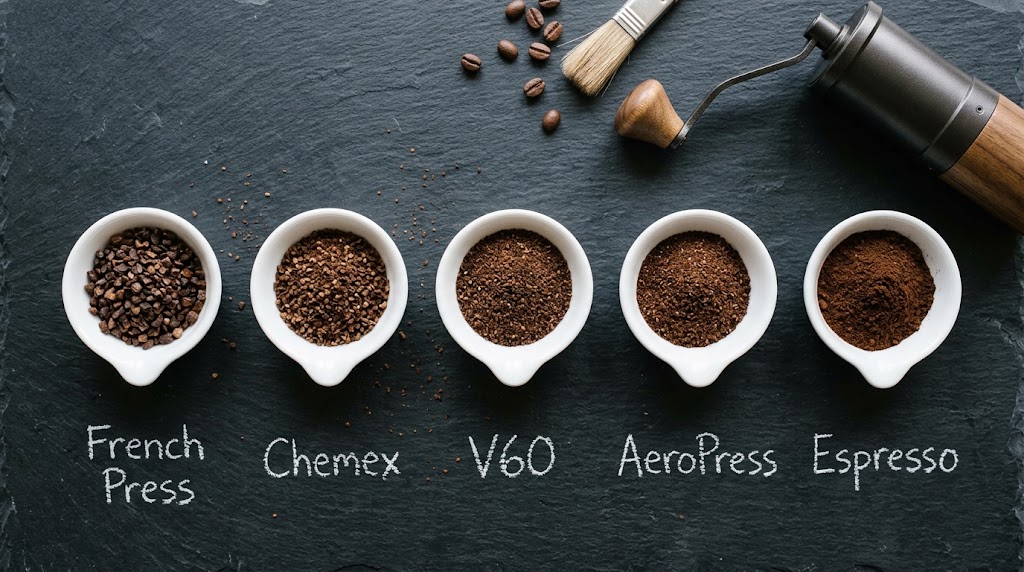
For illustrative purposes only — not the exact product reviewed.
The Pour-Over Grind Size Guide: From Coarse to Fine
Every brewing guide tells you to use a "medium-fine grind." Nobody tells you what that actually means. Grind size is the single most important variable in pour-over brewing, and getting it right transforms a mediocre cup into something genuinely exciting. Here's how to think about particle size, what each range looks like, and how to adjust when something tastes off.
Why Grind Size Matters More Than Anything Else
Coffee extraction is a chemical process. Hot water dissolves flavour compounds from the surface of each ground particle. The finer you grind, the more surface area you expose, and the faster extraction happens. Grind too fine and you pull out harsh, bitter compounds that sit deep in the cell structure. Grind too coarse and the water rushes through before it dissolves the sugars and oils that make coffee taste good.
In pour-over specifically, grind size also controls flow rate. Fine grounds pack tightly together and slow the water down. Coarse grounds leave larger gaps between particles and the water drains quickly. Your total brew time is a direct result of how fine or coarse you've ground.
The Grind Size Spectrum
Think of grind size on a scale from powder to gravel. Here's where each pour-over method typically sits, along with a visual reference you can check against your own grinder's output:
Extra Fine (Turkish/Espresso)
Looks like: Talcum powder or flour. If you rub it between your fingers, it feels silky smooth with almost no grit.
Pour-over use: None. This is too fine for any gravity-fed brewer. Water cannot pass through a bed this dense and your dripper will clog.
Fine
Looks like: Granulated sugar or fine sand. Individual particles are visible but tiny.
Pour-over use: Single-cup V60 brews (12 to 15 grams of coffee) with a fast, aggressive pour technique. Some competition brewers use this range to maximise sweetness extraction, but it demands precise pouring. Beginners should avoid this zone until they're comfortable controlling flow rate.
Medium-Fine
Looks like: Table salt. Each grain is clearly visible and feels slightly gritty between your fingers.
Pour-over use: This is the default starting point for most cone drippers like the Hario V60 and the Timemore Crystal Eye. It balances extraction efficiency with manageable flow rate and produces brew times in the 2 minute 30 second to 3 minute 30 second range for a single cup.
Medium
Looks like: Coarse sand or fine sea salt. Particles are distinct and you can see individual shapes and sizes.
Pour-over use: Flat-bottom drippers like the Kalita Wave 185, multi-cup Chemex batches, and the Clever Dripper in pour-over mode. The restricted drainage holes in these brewers compensate for the faster flow that medium grounds allow.
Medium-Coarse
Looks like: Rough sand or kosher salt. Particles are clearly chunky.
Pour-over use: Large-batch Chemex brews (30 to 45 grams of coffee) with thick Chemex filters. The heavy paper slows drainage, so you compensate with a coarser grind. Also used for some immersion-hybrid methods.
Coarse
Looks like: Sea salt or raw sugar crystals. Chunky, uneven, clearly individual pieces.
Pour-over use: Cold brew concentrate and French press, not typical pour-over. If your pour-over grind looks like this, you've gone too far.
How to Calibrate Your Grinder
Grinder settings aren't universal. "Setting 15" on a Timemore C2 Max produces a completely different particle size than "Setting 15" on a Kingrinder K6. That's because the click resolution, burr geometry, and zero point differ between every grinder model.
The reliable approach:
- Start at your grinder's midpoint setting.
- Grind 15 grams and brew with the recipe from our beginner's guide.
- Time the brew. If it finishes under 2 minutes 15 seconds, grind 2 clicks finer. If it drags past 3 minutes 45 seconds, grind 2 clicks coarser.
- Taste the result. Sour and thin means under-extracted (grind finer). Bitter and harsh means over-extracted (grind coarser).
- Repeat until your brew time lands in the target range and the cup tastes balanced.
Once you find your setting, write it down. Seriously. Mark it on a piece of tape on the grinder if you have to. You'll forget, and hunting for it again wastes good coffee.
The Fines Problem
No grinder produces perfectly uniform particles. Every grind includes a percentage of "fines," tiny dust-sized fragments that extract almost instantly and migrate to the bottom of the filter where they form a dense sludge layer. This is why two cups brewed with the same recipe can taste different: if one has more fines, its drawdown will be slower and its extraction higher.
Better grinders produce fewer fines. This is the primary reason to upgrade from a ceramic-burr grinder to a steel-burr model, and from a 38mm burr to a 48mm burr. You're not paying for faster grinding speed (though that's a bonus). You're paying for a tighter particle distribution that gives you more control over extraction. Our grinder buying guide breaks down exactly what each price tier buys you in terms of grind quality.
Adjusting for Different Beans
The same grind setting won't work for every coffee. Lighter roasts are denser and harder, requiring slightly finer grinding to achieve the same extraction. Dark roasts are more brittle and porous, extracting faster at the same particle size, so you'll want to grind a touch coarser.
Aged or commodity-grade beans that have been sitting on a shelf for months lose their CO2 and internal structure. They grind differently and extract faster than fresh specialty coffee. If you switch from a 3-week-old single origin to a supermarket bag, expect to adjust your grind by 2 to 4 clicks coarser.
Quick Reference Table
| Grind Size | Looks Like | Best For | Typical Brew Time |
|---|---|---|---|
| Fine | Granulated sugar | Competition V60, AeroPress | 1:30 to 2:15 |
| Medium-Fine | Table salt | V60, Origami, most cone drippers | 2:30 to 3:30 |
| Medium | Coarse sand | Kalita Wave, Clever Dripper | 3:00 to 4:00 |
| Medium-Coarse | Kosher salt | Chemex, large batches | 3:30 to 4:30 |
| Coarse | Sea salt crystals | French press, cold brew | 4:00+ |